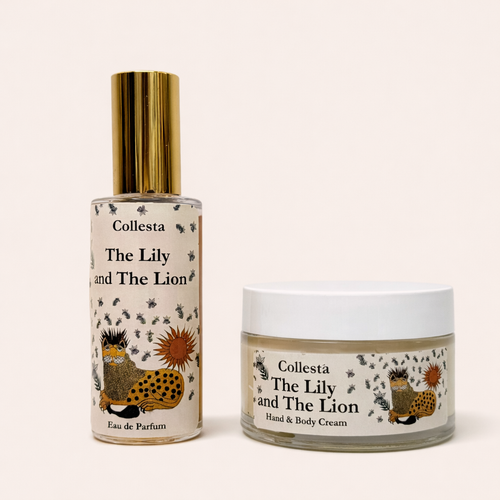
The Collesta Collection
Share
Collesta fragrances are composed as studies in structure, material, and time rather than as seasonal novelties or trend-driven releases. Each composition examines a classical perfumery architecture — fougère, chypre, white floral, amber, powder, or resin — and reinterprets it through small-batch methods and extended maceration.
The collection is unified not by a single signature note but by a shared methodology. Natural materials, tinctures, and historically significant aroma molecules are layered slowly, allowing contrast to emerge through aging rather than immediate impact. Citrus materials provide light, florals establish textural continuity, and resins create persistence and diffusion on skin.
Many compositions explore the relationship between botanical realism and constructed illusion. Carnation is assembled through spice chemistry, gardenia through lactonic structure, violet through ionone architecture, and amber through the dialogue between resin and ambergris. In this way, the fragrances function simultaneously as sensory objects and technical studies.
Powder, moss, and mineral warmth recur throughout the collection, creating continuity without uniformity. Orris butter frequently serves as a cosmetic axis, ambergris as a temporal integrator, and resinous materials as the structural foundation that allows the fragrances to evolve gradually rather than declare themselves immediately.
Several works engage directly with historical perfumery. The chypre reconstruction reflects early twentieth-century contrast between citrus luminosity and moss depth, while the house signature composition establishes a floral-amber vocabulary that informs subsequent fragrances. Other pieces investigate green amber, carnation spice, and luminous vanilla as variations on classical themes.
Collesta perfumes are intended for proximity — compositions that reveal themselves over hours and repeated wear. They privilege texture, restraint, and continuity of impression over projection alone.
Taken together, the collection represents an ongoing exploration of how historical perfumery structures can be preserved, questioned, and extended through contemporary artisanal practice.